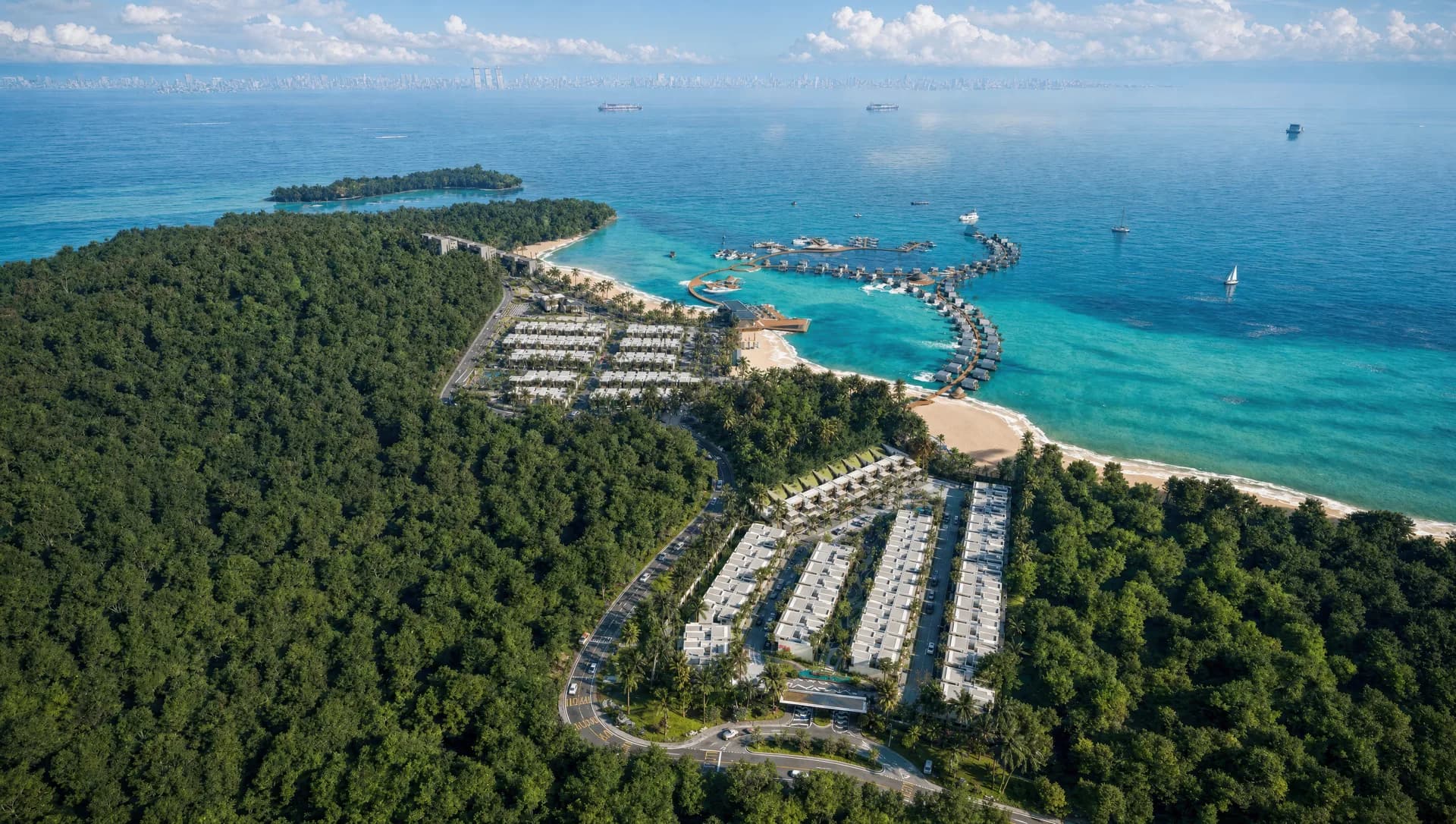
Still Images
Rendered stills for marketing, approvals and submissions — from a single hero view to a full launch set, at the resolutions each channel needs.
A still is the unit most projects are judged on. It goes into the brochure, the hoarding, the planning submission and the sales desk, and it is usually the first thing anyone outside the design team ever sees of a building. We treat it that way: every view is set up from the drawing set, not approximated, so what is rendered is what is consented and what will be built.
Work starts from whatever the project has — massing model, full Revit set, sketch elevations, a site survey. We rebuild what is needed for the camera and no more, because a model detailed far beyond the shot wastes days without changing the image. Where the design is still moving, we set up views that tolerate change, so a facade revision does not mean starting again.
Camera work is the part that decides whether an image sells. An eye-level view at the entry says something different from a three-quarter aerial, and a masterplan reviewer and a marketing director want different things from the same building. We propose views with a reason attached, and we would rather argue for a better angle than deliver a list of shots that all look alike.
Light is chosen for the building rather than for the render. A west-facing facade at golden hour is a cliche because it flatters everything; sometimes flat overcast is the honest choice for a submission, and sometimes dusk is right because the scheme is about a lit ground plane. We will tell you which we think it is.
Materials come from the specification where one exists. If the brief calls for a particular brick, a particular anodised finish, a particular timber, we source and match it rather than substituting something that reads similarly. On projects with a long review cycle this matters more than it sounds: committees notice when the render and the sample board disagree.
People and planting are placed to give scale and to show intended use, not to fill space. Density is a decision — a plaza rendered at festival crowding sets an expectation the finished square will not meet, and reviewers are quick to say so.
Delivery is whatever the channel needs. Print resolution for brochures and boards, sized crops for social and web, and layered files where your team wants to adjust text or colour in-house. Every image is delivered in the aspect ratios agreed at the outset rather than cropped down from one master afterwards.
Revisions are expected and scoped up front. Two rounds are typical for a single hero image; a large launch set works better with a review at grey-shade stage, before materials and light are committed, because that is where changes are cheap.
How this service runs.
- 01
Brief and view selection
We review the drawing set and agree the shot list with a reason for each view — what it has to prove and who it is for.
- 02
Model and blockout
The model is built or adapted to the camera. Grey-shade blockouts go back for approval before any material or lighting work begins.
- 03
Materials and light
Finishes are matched to the specification and the lighting condition is chosen for the building, not for the render.
- 04
Draft review
Full-quality drafts at working resolution. This is the round where composition and content change.
- 05
Refinement
Entourage, planting and detail passes, plus any corrections carried from review.
- 06
Delivery
Final files at the agreed resolutions and aspect ratios, with layered versions where your team needs to edit in-house.
Loading work…
Still Images by sector
- What do you need to start?
- Whatever exists: a drawing set, a model, elevations, a site survey. We will tell you quickly whether it is enough or what is missing.
- How long does a still take?
- A single view from a complete model is typically one to two weeks including review. A launch set of ten to twenty is usually four to six.
- Can you match an existing visual style?
- Yes. Send the reference set and we will match treatment across the new work so a phase two sits beside phase one without looking different.
- What resolution do we get?
- Print resolution as standard, plus the web and social crops you specify. Larger formats for hoardings and boards on request.